How Long Do Brake Pads Last? What Actually Determines Brake Life
One of the most common questions drivers ask is:
“How long should my brake pads last?”
Unfortunately, there isn’t a simple mileage number that applies to every vehicle.
Some drivers need brake pads at 25,000 miles. Others drive well beyond 70,000 miles before replacement becomes necessary. We’ve even seen two identical vehicles with dramatically different brake wear despite having similar mileage.
The reason is simple: brake pads don’t wear based solely on miles driven. They wear based on how the vehicle is driven, where it’s driven, the condition of related vehicle systems, and how well routine maintenance is performed.
At Rick’s Tire & Auto Service, we’ve helped Irving drivers maintain safe, reliable vehicles for decades. One thing we’ve learned is that understanding what affects brake life can help drivers avoid expensive repairs, improve safety, and get more life from their entire braking system.
So How Long Should Brake Pads Last?
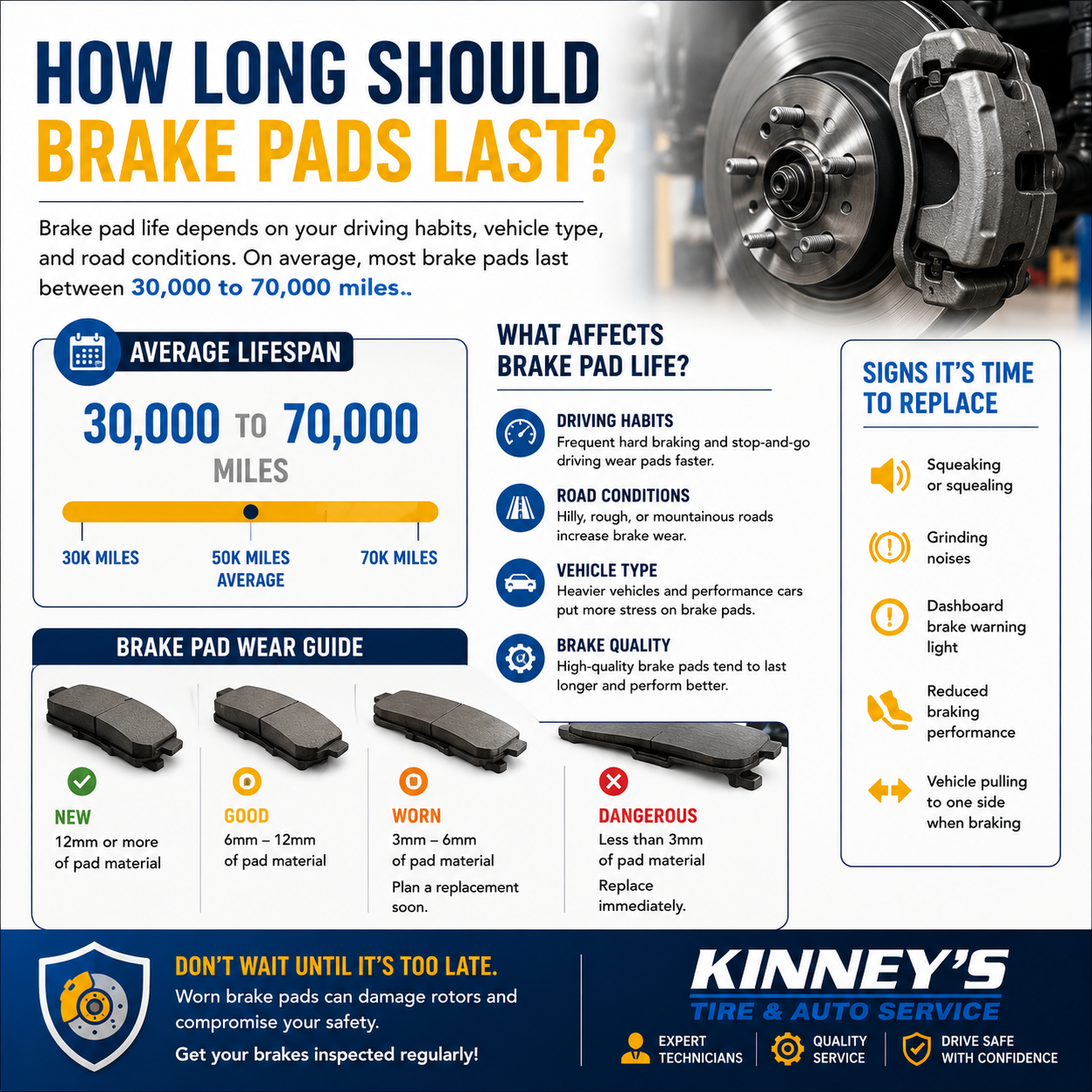
Most brake pads last somewhere between 30,000 and 70,000 miles.
That’s the general answer.
The more useful answer is that brake pad life depends heavily on driving conditions.
A vehicle that spends most of its life cruising on highways may use its brakes surprisingly little. Meanwhile, a vehicle driven through stop-and-go traffic every day may wear through brake pads much faster despite accumulating fewer total miles.
A Real-World Example
We’ve inspected vehicles with more than 60,000 miles that still had substantial brake pad life remaining.
We’ve also seen vehicles approaching replacement needs before 30,000 miles.
In most cases, the difference wasn’t the brake pads.
It was the daily commute.
Your Commute May Matter More Than Your Mileage
Many drivers focus on mileage because it’s easy to measure.
Brake systems don’t care about mileage.
They care about braking events.
A driver who travels twenty miles on the highway may use the brakes less than someone driving five miles through city traffic.
Every time you press the brake pedal, a small amount of friction material wears away.
The more often that happens, the faster brake pads wear.
What We See Every Day
Customers are often surprised when two family vehicles with similar mileage need brakes at completely different times.
Once we discuss how each vehicle is used, the difference usually makes sense.
The vehicle spending most of its time in heavy traffic almost always wears brakes faster than the one spending most of its time on open roads.
Driving Habits Play a Bigger Role Than Most People Realize
The way you drive affects brake life just as much as where you drive.
Hard braking creates more heat.
Late braking creates more heat.
Following too closely creates more braking events.
Over time, that additional heat and friction accelerate brake wear.
Something We’ve Noticed Over the Years
Drivers who leave extra following distance often get significantly more life from their brake pads.
Not because they’re driving slower.
Because they’re braking more gradually.
A small change in driving habits can add thousands of miles to brake pad life.
Towing and Heavy Loads Can Shorten Brake Life
Vehicles carrying extra weight require more stopping force.
That includes:
- Trailers
- Boats
- Work equipment
- Cargo
- Large passenger loads
Every stop requires the brake system to absorb more energy.
That extra workload naturally increases wear on brake pads, rotors, and other braking components.
For trucks and SUVs used for towing in TX, brake inspections become even more important.
What Tires Have to Do With Brake Life
Most drivers think of brakes and tires as completely separate systems.
From a technician’s perspective, they’re closely connected.
Your tires provide the traction that allows your brakes to do their job.
When tire performance declines, braking performance often declines with it.
A Situation We See Frequently
Customers sometimes come in convinced their brakes are wearing out because stopping distances feel longer than normal.
After inspection, the brake pads still have plenty of life remaining.
The actual issue turns out to be:
- Worn tires
- Improper tire pressure
- Alignment problems
- Uneven tire wear
The brakes aren’t working harder because they’re bad.
They’re working harder because traction has been reduced.
That’s one reason our brake inspections often include tire evaluations.
Learn more about Rick’s Tire & Auto Service’s tire services and tire replacement options.
Alignment Problems Can Indirectly Affect Brake Wear
Alignment problems don’t directly wear out brake pads.
However, they often create conditions that affect braking performance and vehicle stability.
What Most Drivers Don’t Realize
A vehicle can be significantly out of alignment without pulling noticeably.
By the time a driver notices handling issues, uneven tire wear may already be occurring.
Poor alignment can contribute to:
- Uneven tire wear
- Reduced traction
- Steering instability
- Additional stress during braking
This is one reason wheel alignments are often recommended alongside tire and brake inspections.
Sometimes Brake Wear Starts Somewhere Else
Many drivers assume brake wear begins and ends with the braking system.
In reality, suspension and steering problems frequently influence how the braking system performs.
Worn components can affect:
- Weight transfer during braking
- Tire contact with the road
- Vehicle stability
- Brake pad wear patterns
A Real-World Shop Observation
Drivers often come in complaining about brake vibration.
Sometimes the brakes are responsible.
Other times, the real culprit is suspension wear that’s allowing the vehicle to move unpredictably under braking.
Replacing brake parts without addressing the underlying cause often fails to solve the problem completely.
Your Vehicle Usually Warns You Before Brake Pads Wear Out
Brake pads rarely fail without warning.
The challenge is that many drivers don’t recognize the warnings until the wear becomes significant.
Common Signs of Brake Wear
- Squealing or squeaking noises
- Grinding sounds
- Longer stopping distances
- Brake vibration
- Pulling during braking
- Dashboard brake warning lights
- A soft brake pedal
Something We Frequently Discover
Modern vehicles are much quieter than they were twenty years ago.
Between improved sound insulation, highway driving, phone calls, and everyday distractions, many drivers don’t notice early brake noises.
We’ve discovered severely worn brake pads during routine oil changes simply because the driver never noticed a clear symptom.
That’s one reason regular inspections are so valuable.
Why Waiting Can Get Expensive
Brake pads are usually one of the least expensive parts of the braking system to replace.
Rotors are not.
Calipers are not.
Wheel bearings are not.
A Common Scenario
A driver begins hearing brake squeal.
The vehicle still stops normally, so the inspection gets postponed.
Several months later the squeal becomes grinding.
Now the repair may include:
- Brake pads
- Rotor replacement
- Additional labor
- Brake hardware
What could have been routine maintenance becomes a significantly larger repair.
This Happens Throughout the Vehicle
The same pattern appears in other systems:
- Alignment issues become tire replacement
- Suspension wear becomes uneven tire wear
- Cooling system leaks become overheating repairs
- Minor steering issues become larger suspension repairs
Early diagnosis almost always provides more repair options and lower repair costs.
How Often Should Brakes Be Inspected?
Most automotive professionals recommend brake inspections at least once per year.
Many drivers combine brake inspections with:
- Oil changes
- Tire rotations
- State inspections
- Routine maintenance visits
This makes it easier to monitor wear and identify developing concerns before they affect safety.
At Rick’s Tire & Auto Service, inspections often include evaluating:
- Brake pads
- Rotors
- Tires
- Suspension components
- Steering components
- Alignment-related concerns
Because these systems work together, examining them together often provides the clearest picture of overall vehicle health.
Brake Performance Is About More Than Brake Pads
One of the biggest misconceptions drivers have is thinking braking performance comes entirely from the brake system.
In reality, braking performance depends on several systems working together.
Your brakes provide stopping force.
Your tires provide traction.
Your suspension keeps the tires connected to the road.
Your steering system helps maintain vehicle stability.
When one system develops problems, the others are affected.
That’s why comprehensive vehicle inspections often reveal concerns that aren’t immediately obvious from the driver’s seat.
A Local Alternative to the Dealership for Brake Service in Irving
At Rick’s Tire & Auto Service, we’ve helped Irving-area drivers maintain safe, reliable vehicles since the early 1990s.
Whether you need:
- Brake inspections
- Brake repairs
- Tire service
- Wheel alignments
- Suspension repairs
- Oil changes
- Diagnostics
- Preventive maintenance
our team provides the same professional expertise many drivers expect from a dealership while delivering the personalized service and transparency of a locally owned shop.
We focus on identifying the actual cause of vehicle concerns rather than simply replacing parts.
Need Repairs Now?
Many drivers delay brake repairs because of budget concerns.
Unfortunately, postponing maintenance often increases repair costs over time.
That’s why Rick’s Tire & Auto Service offers financing options that can help drivers address important brake, tire, maintenance, and repair needs without unnecessary delays.
Brake Pads Don’t Follow a Schedule. They Follow Your Driving Habits
There isn’t a universal mileage where every vehicle needs brakes.
Traffic, driving style, vehicle weight, tire condition, suspension health, and maintenance habits all play a role.
The best way to maximize brake life isn’t trying to predict a mileage number.
It’s inspecting the system regularly, addressing related vehicle issues early, and identifying wear before it turns into a larger repair.
If your brakes are making noise, your vehicle doesn’t feel quite right, or it’s been a while since your last inspection, having the system evaluated now can help you avoid surprises later.