
Tire Balancing and Road Force Balancing in Irving, TX
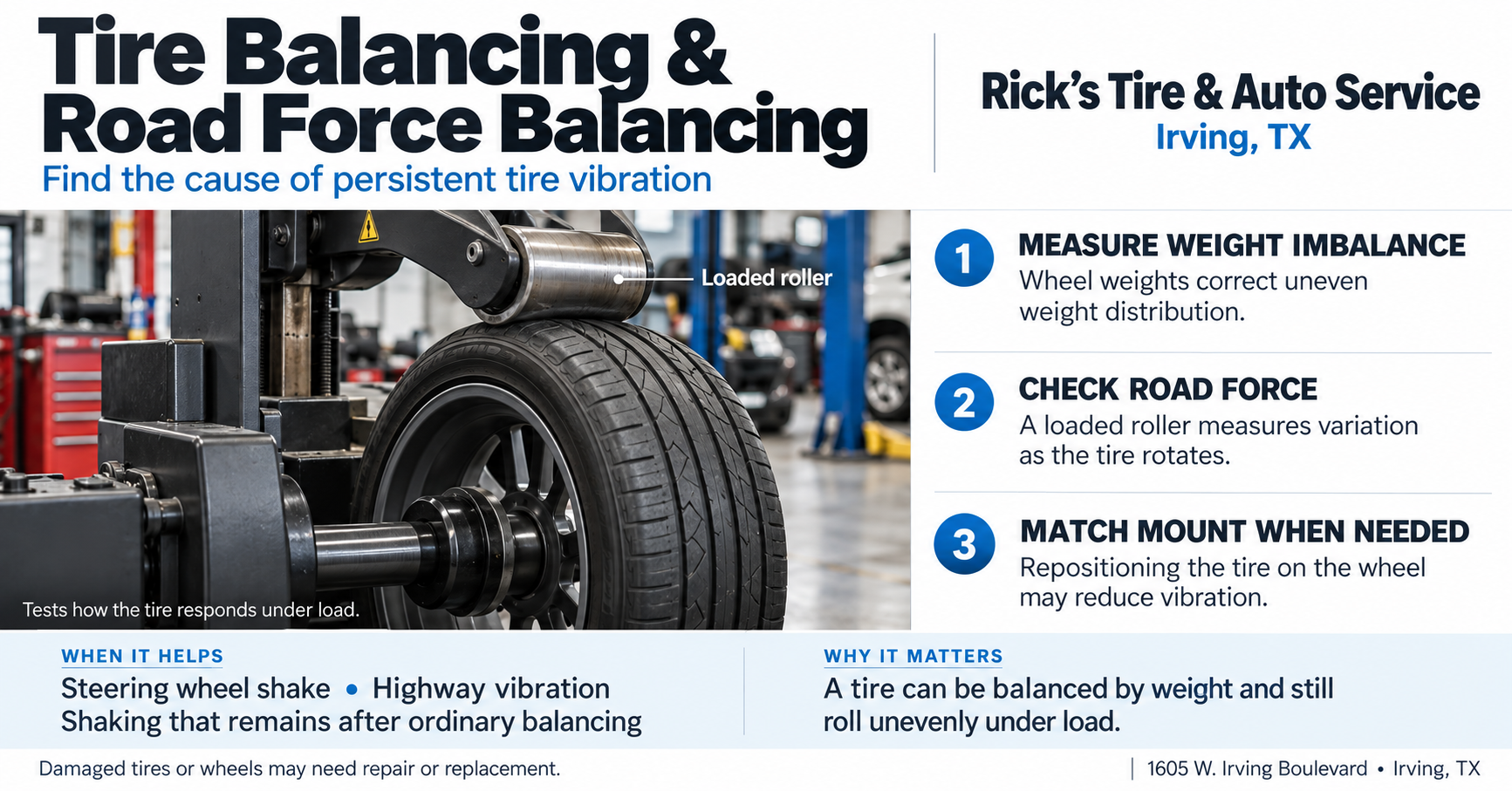
Rick’s Tire & Auto Service offers tire balancing and road force balancing in Irving, Texas, at 1605 W. Irving Boulevard. Our services help identify and correct tire and wheel conditions that cause steering wheel shake, highway vibration, and an uncomfortable ride.
Conventional balancing corrects uneven weight distribution in a tire and wheel assembly. Road force testing goes further by measuring how that assembly behaves under load. This additional information is especially useful when your tires have already been balanced but the vehicle still vibrates.
Whether you are installing new tires or investigating a recurring shake, we can help determine which service your vehicle needs.
Why Tires Need Balancing
A tire and wheel may look uniform, but small differences in their combined weight distribution can affect how smoothly they rotate. As vehicle speed increases, that imbalance can become noticeable through the steering wheel, seat, or floor.
Computerized balancing measures the imbalance and identifies the amount and placement of corrective wheel weights. Properly positioned weights counteract the uneven mass distribution, helping the assembly rotate more smoothly.
Balance can change during a tire’s service life. A lost wheel weight, changes in tread wear, or removing and remounting a tire can create a need for another balance check. New tire and wheel combinations should also be balanced during installation.
What Road Force Balancing Adds
Road force balancing combines conventional weight balancing with a loaded-roller test that evaluates how evenly a tire and wheel roll under pressure.
During testing, a roller presses against the rotating tire’s tread. This allows the equipment to measure variations that may remain undetected when the assembly spins without a load.
A tire can have slightly different stiffness around its circumference. As those sections contact the road, they can exert different forces on the vehicle, producing vibration even when the assembly’s weight balance is correct. This is called radial force variation.
Rick’s road force balancing service helps investigate these concerns, giving us additional information when ordinary balancing has not resolved a rough ride.
How Match Mounting Can Improve Ride Quality
Road force measurements can help determine whether changing the tire’s position on the wheel would improve the assembly.
This adjustment is called match mounting. The tire is repositioned around the same wheel so the characteristics of the two components work together more favorably. For example, aligning a tire’s measured stiff spot with the appropriate low point of the wheel can reduce the combined variation.
The assembly is then balanced and checked again to evaluate the improvement.
Match mounting is different from tire rotation, which moves assemblies between positions on the vehicle. It also does not repair damage. If a tire or wheel cannot provide acceptable results, replacement or further evaluation may be necessary.
What Our Tire Balancing and Road Force Service Involves
The appropriate service depends on your symptoms, tire condition, and previous repair history. Our evaluation focuses on the complete tire and wheel assembly.
1. Review the Vibration
We start with the circumstances surrounding the problem. Does the steering wheel shake at a particular speed? Is the vibration stronger through the seat? Did it begin after tire replacement, rotation, or a pothole impact?
Tell us whether previous balancing improved the ride, even temporarily.
2. Inspect the Tires and Wheels
The inspection considers inflation pressure, tread wear, visible damage, and the condition of the wheels. Missing weights, irregular wear, or a damaged tire can help explain a change in ride quality.
These findings also help determine whether balancing is an appropriate correction.
3. Measure Weight Imbalance
The assembly is mounted and centered on the balancing equipment. Accurate centering matters because an incorrectly mounted wheel can produce misleading measurements.
The equipment identifies the weight correction needed, and suitable weights are placed in the indicated locations.
4. Evaluate Road Force When Needed
For road force service, the loaded roller measures the assembly’s behavior under pressure. Correct tire inflation is important for meaningful results.
The measurements help guide decisions about match mounting, additional inspection, or a tire or wheel that needs further attention.
5. Check the Results
After an adjustment, the assembly is checked again. If the findings do not explain the vibration, further diagnosis may be needed rather than repeating the same balancing procedure.
When Should You Schedule a Balance Check?
A tire balance inspection makes sense when you notice:
- Steering wheel shake while cruising, particularly within a specific speed range.
- Vibration through the seat or floor that changes with road speed.
- A rough ride after new tire installation or after a tire has been removed and remounted.
- A change after tire rotation, which may make an existing concern more noticeable.
- Persistent vibration after previous balancing, making road force testing particularly useful.
- A new vibration after a pothole or curb impact, which also calls for a damage inspection.
The circumstances matter. Shaking mainly during braking may involve the brakes, while vibration under acceleration may require drivetrain or other checks. Describe when the problem occurs so we can investigate the right systems.
How Often Should Tires Be Balanced?
There is no single balancing interval that applies to every vehicle and tire combination. Follow your vehicle and tire manufacturer’s recommendations, and arrange an inspection when ride quality changes.
Important times to consider balancing include:
- During new tire installation: The new tire and wheel combination needs to be balanced.
- After tire removal and remounting: Service can change the assembly’s balance.
- When vibration develops: A new or worsening shake deserves an inspection.
- During routine tire maintenance: Rotation appointments provide an opportunity to discuss vibration and examine wear.
Road force testing does not need to be repeated automatically at every rotation. It is particularly valuable when symptoms suggest a rolling-uniformity concern or conventional balancing has not provided a satisfactory result.
Tire Balancing, Road Force Testing, Rotation, and Alignment
These services address different aspects of tire performance:
| Service | What it addresses |
|---|---|
| Tire balancing | Uneven weight distribution in the mounted tire and wheel. |
| Road force testing | Variation in how the assembly rolls under load. |
| Tire rotation | Differences in wear associated with tire position on the vehicle. |
| Wheel alignment | Wheel angles that affect tracking and tread contact. |
Tire rotation does not automatically correct imbalance, and wheel alignment does not eliminate tire force variation. A vehicle with vibration and uneven wear may benefit from more than one service.
What Balancing Can—and Cannot—Correct
Proper balancing can reduce vibration caused by uneven mass distribution and help limit wear associated with that imbalance. Road force testing adds information that can help improve the ride when weight correction alone is insufficient.
However, neither service restores worn tread, repairs a damaged sidewall, or straightens a bent wheel. Severe irregular wear may also continue to affect ride quality after an assembly has been balanced.
Our goal is to identify a useful correction and explain when another repair or replacement would be more appropriate.
Tire Balancing and Road Force FAQs
Can a tire be balanced and still cause vibration?
Yes. Correct weight balance does not guarantee uniform rolling behavior under load. Road force testing helps investigate this difference. Vibration can also originate elsewhere in the vehicle.
Can new tires need road force balancing?
Yes. New tires still have manufacturing variations, and their interaction with the wheels can affect ride quality. Road force testing can help investigate vibration that appears after installation.
Will road force balancing fix every highway vibration?
No. It addresses tire and wheel concerns, but suspension, steering, drivetrain, and other conditions may also cause vibration. The results help determine whether further investigation is needed.
Can a missing wheel weight cause shaking?
Yes. Losing a corrective weight changes the assembly’s balance. An inspection can confirm whether a missing weight explains the symptom.
How much does road force balancing cost?
The estimate depends on the assemblies being serviced and whether match mounting or additional work is needed. Contact Rick’s with your vehicle information and symptoms to discuss the appropriate service.
Schedule Tire Balancing and Road Force Balancing in Irving
A recurring vibration deserves a closer look, especially if your tires have already been balanced. Rick’s Tire & Auto Service provides conventional balancing, road force balancing, and related tire services to help Irving drivers address rough rides and care for their tires.
Visit us at 1605 W. Irving Boulevard, Irving, TX 75061. When scheduling, tell us where you feel the vibration, the speeds at which it occurs, and any recent tire or wheel work.