Can a Check Engine Light Come On for an Oil Change? Oil-Change Light vs. Check Engine Light
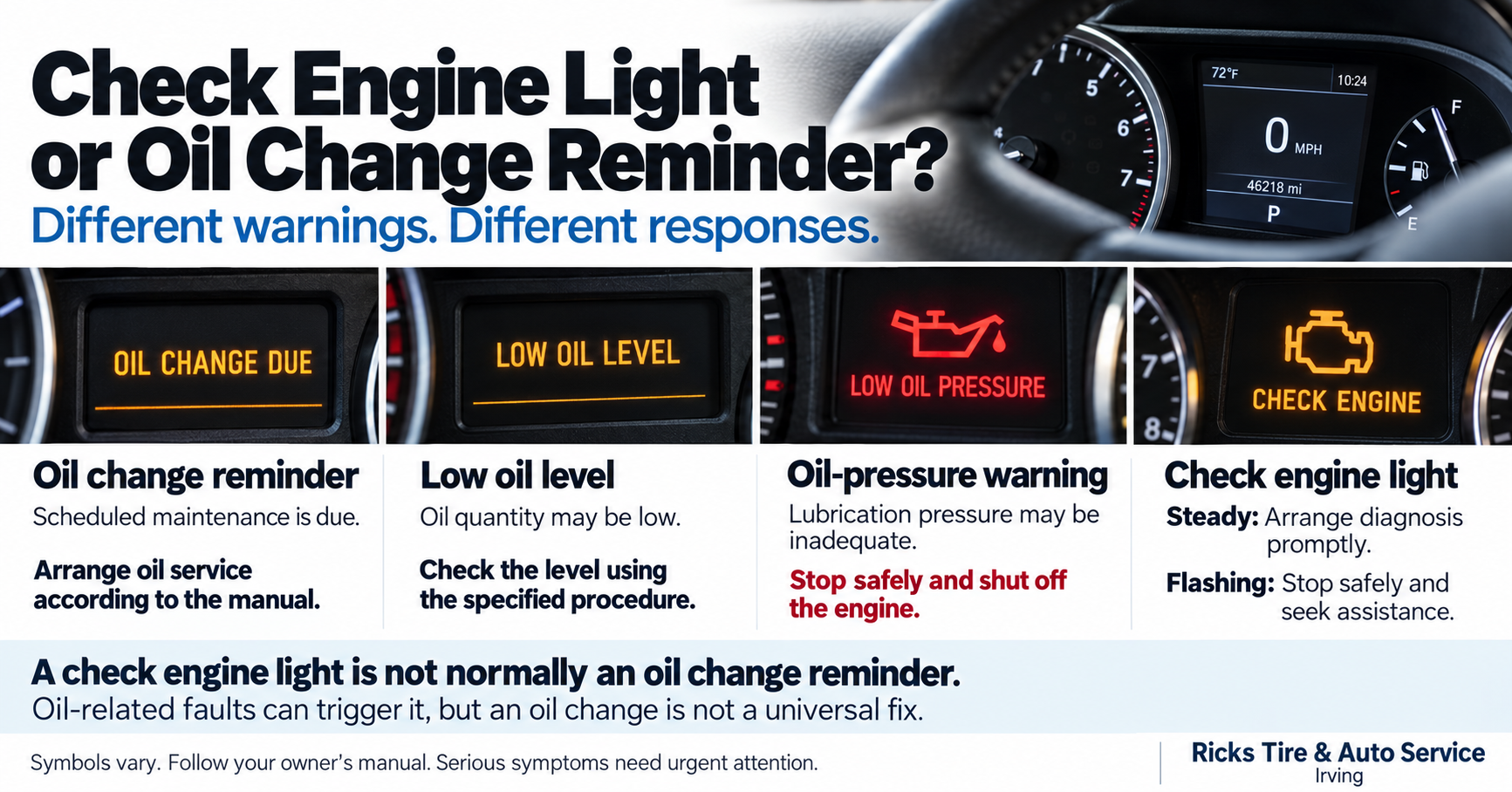
A check engine light is not normally a routine oil change reminder. However, oil-related problems can sometimes trigger it by affecting monitored engine systems. An oil change reminder, a low oil level message, and an oil pressure warning mean different things and require different responses.
Dashboard warnings can be confusing, especially when several symbols appear close together.
A driver may see an engine-shaped light and assume the car is asking for an oil change. Another may see an oil can symbol and think it can wait until the next service appointment.
That confusion can lead to the wrong response.
Some messages indicate scheduled maintenance. Others indicate a fault that needs diagnosis. An oil-pressure warning can require stopping the engine immediately.
For Irving drivers, identifying the exact warning is the first step.
Do not decide what to do from the word “oil” or “service” alone.
The Main Warning Types
| Warning or message | General meaning | Appropriate response |
| Oil change reminder | Scheduled oil service is due or approaching | Arrange service according to the manual |
| Oil life percentage | Estimated remaining service life | Follow the vehicle’s instructions |
| Low oil level message | Oil quantity may be low | Check using the specified procedure |
| Oil pressure warning | Lubrication pressure may be inadequate | Stop safely and shut off the engine |
| Steady check engine light | A monitored engine or emissions fault is detected | Arrange diagnosis promptly |
| Flashing check engine light | Often a serious misfire or running fault | Stop safely and seek guidance or assistance |
Symbols and wording vary.
Your owner’s manual is the authority for the exact message on your vehicle.
What Does an Oil Change Reminder Mean?
An oil change reminder indicates maintenance timing.
It may be based on mileage, elapsed time, operating conditions, or a combination.
Examples include messages such as “Change Engine Oil Soon” or “Maintenance Required.”
The reminder does not necessarily mean the engine has low oil pressure or is experiencing an active mechanical failure.
However, it should still be addressed according to the manufacturer’s instructions.
After the service is completed, the reminder is reset.
Resetting it without changing the oil only changes the display. It does not improve lubrication or complete the maintenance.
What Does the Check Engine Light Mean?
The check engine light is part of the vehicle’s monitoring system.
It indicates that the control system has detected a condition requiring attention.
Possible causes range from relatively minor emissions-system issues to faults affecting engine operation.
The light alone does not identify the failed part.
A diagnostic trouble code provides a starting point, but further testing may be needed to determine the cause.
That is why replacing a component solely because its name appears in a code description can be ineffective.
Ricks Tire provides check engine light diagnostics in Irving to investigate the underlying condition.
Can Being Overdue for an Oil Change Trigger It?
Simply reaching an oil change interval does not normally trigger the check engine light as a routine reminder.
However, neglected oil service can contribute to conditions that affect monitored systems.
For example, some engines use oil pressure and flow to operate variable valve timing components.
Insufficient oil, unsuitable viscosity, contamination, or a mechanical problem may interfere with their operation.
The resulting fault can trigger a check engine light.
That does not mean every timing-related code is solved by an oil change.
The oil level and condition are part of the diagnostic process, not a universal repair.
Can Low Oil Cause a Check Engine Light?
It can in some circumstances.
Low oil may affect the operation of systems that depend on lubrication and oil pressure.
The resulting malfunction may be detected by the engine control system.
However, the check engine light is not a reliable low-oil warning.
Some vehicles have a separate level sensor. Others may not warn until a pressure-related condition develops.
Do not wait for the check engine light before checking the oil.
Use the routine specified in the owner’s manual.
Oil Level and Oil Pressure Are Different
Oil level is the quantity in the engine.
Oil pressure concerns the lubrication system while operating.
A low level can contribute to a pressure problem, but pressure can also be inadequate with a correct level.
Possible causes include pump faults, restrictions, internal wear, or other mechanical problems.
A sensor or wiring issue is another possibility, but it should not be assumed before testing.
Ford’s owner guidance, for example, directs drivers to stop safely and switch off the engine when a low oil pressure warning appears. Source: Ford
The practical rule is to treat a pressure warning as urgent until the cause is established.
What Should You Do if the Oil-Pressure Light Comes On?
Safely move out of traffic and shut off the engine.
Follow the owner’s manual.
Do not continue driving to see whether the light disappears.
If it is safe to check the level, use the specified procedure. Add the correct oil only if the level is low and the manual permits that response.
Even then, do not assume the underlying problem is resolved.
A correct level does not rule out a pressure fault.
If the warning remains, the level is correct, or there are noises or other serious symptoms, arrange professional assistance.
Steady vs. Flashing Check Engine Light
A steady check engine light often allows time to arrange a diagnosis, but the vehicle’s symptoms still matter.
If the engine is running roughly, overheating, losing power, or making unusual noises, continued driving may be inappropriate even if the light is steady.
A flashing check engine light often signals a misfire severe enough to risk damage to the catalytic converter.
Reduce load, stop safely, and seek assistance or follow the manufacturer’s specific instructions.
Do not assume a flashing light means the oil change reminder has become more urgent.
It is a different warning.
Why a Light Might Appear After an Oil Change
The timing is useful information, but it does not prove that the oil service caused the fault.
A maintenance reminder may simply not have been reset.
An unrelated fault may have appeared around the same time.
There may also be a service-related issue, such as an incorrect oil level or a disturbed component, depending on the vehicle and work performed.
The correct response is to identify the exact light and report the timing to the shop.
Do not clear the code before useful diagnostic information is recorded.
If the warning is an oil pressure light or the engine develops serious symptoms, stop rather than driving back without guidance.
Can the Wrong Oil Trigger a Fault?
An unsuitable oil can affect engine operation.
The required viscosity and approvals matter, especially in engines with oil-operated timing systems and other specific lubrication demands.
However, a code should not automatically be blamed on the oil without checking what was used and testing the system.
An electrical fault, mechanical wear, a control valve, or another component may be involved.
Accurate service records help.
Bring the invoice showing the oil and filter installed.
That provides a starting point for evaluation.
Can an Oil Change Turn the Check Engine Light Off?
Sometimes correcting an oil-related condition resolves the cause of the light.
But an oil change is not a general check engine light repair.
If the fault is an ignition problem, air leak, sensor issue, fuel system concern, or another condition, changing oil may have no effect.
Even when the oil is involved, additional repair may be necessary.
The correct sequence is to diagnose the condition, perform the appropriate work, and verify the result.
Replacing oil first without understanding the fault can waste time and delay the needed repair.
Why a Code Scan Is Not a Complete Diagnosis
A scan retrieves information stored by the vehicle.
That information can identify the detected system or condition.
It does not always identify which part failed.
For example, a timing performance code may involve oil supply, a control solenoid, wiring, mechanical timing, or another issue.
A sensor-related code may reflect a wiring problem or an abnormal condition that the sensor is correctly reporting.
Diagnostic work uses the code alongside operating data, service information, inspection, and testing.
That is different from replacing the first component named in the description.
Should You Disconnect the Battery to Reset the Light?
Not as a repair.
Disconnecting the battery may clear information or reset settings on some vehicles, but it does not correct the cause.
It can also erase useful diagnostic data and affect readiness information.
A light that goes away temporarily can return once the system detects the fault again.
If the goal is to understand the problem, preserve the information and arrange a diagnosis.
Maintenance reminders should be reset through the proper procedure after service, not confused with fault clearing.
What Information Helps the Technician?
Describe the exact warning and whether it is steady or flashing.
Note when it appeared.
Was the engine cold? Were you accelerating? Was the vehicle recently serviced? Did it happen after refueling?
Mention rough running, smoke, smells, temperature changes, or unusual noises.
Bring maintenance records and any code information already retrieved.
Avoid changing multiple parts or adding products before the appointment.
A clear history can help the technician reproduce or narrow an intermittent concern.
Do Not Confuse “Service Engine Soon” With an Oil Reminder
Manufacturers use different wording.
On some vehicles, “Service Engine Soon” is the check engine light, not a routine maintenance request.
On others, maintenance messages appear separately.
Read the manual for the exact display.
A familiar-sounding phrase is not enough to determine urgency.
If you cannot identify the symbol, photograph it while safely parked and share it with the shop.
Do not attempt to take the photo while driving.
Routine Oil Service Still Matters
Separating warning lights does not make oil changes less important.
Correct oil and filter service supports lubrication and helps keep maintenance on schedule.
The point is that scheduled service and fault diagnosis should not be confused.
Ricks Tire offers oil change service in Irving for routine maintenance.
If a warning is present, mention it when booking so the appointment can include the appropriate evaluation rather than assuming an oil change will address it.
What if the Car Seems to Drive Normally?
A vehicle can run normally while a monitored fault is present.
That does not mean the light should be ignored.
Some faults affect emissions, efficiency, or a system that has not yet produced obvious symptoms.
Arrange diagnosis and follow the owner’s manual.
At the same time, avoid assuming every steady light means immediate engine failure.
The right response is proportional: Identify the warning, assess symptoms, and investigate.
Build a Maintenance Plan That Reduces Confusion
Keep records of oil changes and other scheduled work.
Know where to find the owner’s manual and how the vehicle displays maintenance information.
Check the oil level as instructed.
If the vehicle has recurring warnings, keep notes about the circumstances.
Ricks Tire’s factory-scheduled maintenance services can help keep routine needs organized.
That makes it easier to distinguish a service that is due from a new fault that needs diagnosis.
Fall Car Care: Resolve Warning Lights Before Travel
An unexplained dashboard light is worth addressing before a fall road trip.
Longer driving can make an existing problem more inconvenient, and arranging service away from home can be difficult.
Review oil service, tire condition, brakes, coolant, lights, and starting performance.
Use the Car Concepts fall car care checklist to organize the broader inspection.
Do not reset a warning merely to make the dashboard look ready for the trip.
Frequently Asked Questions
Will the check engine light come on when an oil change is due?
Usually, the vehicle uses a separate maintenance reminder. Oil-related faults can sometimes trigger the check engine light, but being due for service is not normally its direct purpose.
Can low oil trigger a timing code?
It can affect oil-operated systems in some engines. The code still requires diagnosis because other causes are possible.
Is the oil can symbol a maintenance reminder?
It may indicate oil pressure or oil level, depending on the vehicle. Identify it in the owner’s manual. A pressure warning while running is urgent.
Can I drive with a steady check engine light?
Follow the manual and consider symptoms. Arrange diagnosis promptly. Stop if serious running problems, overheating, unusual noises, or other urgent warnings appear.
Why is the maintenance light still on after service?
The reminder may not have been reset, or the displayed message may concern a different maintenance item. Ask the shop to verify it.
Should an oil change include clearing engine codes?
Not automatically. Fault codes should be handled as part of the diagnosis and repair process, not erased simply because routine maintenance was performed.
Get the Right Warning Diagnosed in Irving
The correct response depends on which light is on and how the vehicle is behaving.
For scheduled maintenance, arrange an oil change at Ricks Tire & Auto Service.
For an unexplained check engine light, schedule diagnostic service and describe the symptoms.
If an oil-pressure warning appears while the engine is running, stop safely and shut it off. Identifying the warning correctly is the first step toward protecting the engine and choosing the right service.