
Recommended Oil Change Interval by Driving Type and Engine Specifications
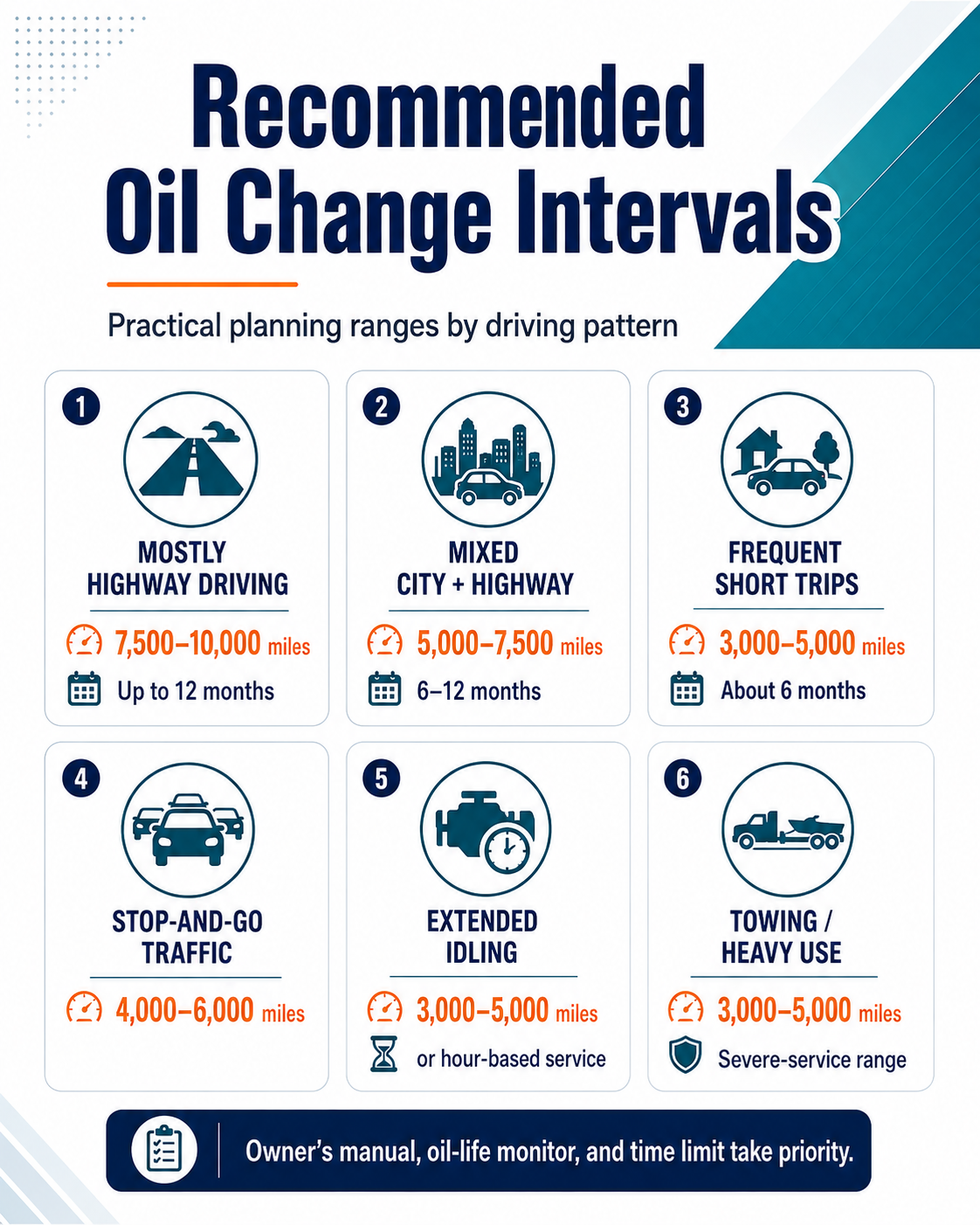
Recommended Oil Change Interval by Driving Type and Engine Specifications
Few maintenance questions produce more conflicting answers than how often engine oil should be changed.
One driver still follows the traditional 3,000-mile rule. Another waits until the dashboard oil-life monitor reaches zero. A full-synthetic oil bottle may advertise protection for 15,000 or 20,000 miles, while the vehicle’s maintenance guide specifies a much shorter interval. A repair shop may recommend 5,000 miles, even though the owner’s manual permits 10,000 miles under ideal operating conditions.
Each recommendation may make sense in a particular context.
The correct oil-change interval depends on more than whether the oil is conventional or synthetic. It is determined by the vehicle manufacturer’s requirements, engine design, oil specification, filter capacity, driving pattern, operating temperature, mileage, time, idling, towing, fuel dilution, and the engine’s current mechanical condition.
As a broad planning guide:
| Driving pattern or engine use | Practical planning range when permitted by the manufacturer |
| Mostly highway driving under light load | 7,500-10,000 miles or up to 12 months |
| Mixed city and highway driving | 5,000-7,500 miles or 6-12 months |
| Frequent short trips | 3,000-5,000 miles or about 6 months |
| Heavy stop-and-go traffic | 4,000-6,000 miles |
| Extended idling | 3,000-5,000 miles or an engine-hour-based interval |
| Regular towing or heavy hauling | 3,000-5,000 miles under severe use |
| Dusty, off-road, or construction-site operation | 3,000-5,000 miles, with frequent filter inspections |
| Turbocharged gasoline engine | Commonly 5,000-7,500 miles unless the manufacturer specifies otherwise |
| Hybrid vehicle | Often 5,000-10,000 miles, but usually no longer than the manufacturer’s time limit |
| Light-duty diesel | Frequently 5,000-10,000 miles depending on duty cycle and oil-life monitoring |
| Performance or track use | Potentially after each event or within 3,000-5,000 miles, depending on manufacturer guidance |
| Vehicle driven very little | Usually at least once every 12 months; sooner under severe short-trip use |
These ranges are not universal specifications. Your owner’s manual, maintenance guide, oil-life monitor, and engine-specific requirements take priority.
Rick’s Tire & Auto Service provides professional oil change service in Irving, TX, using vehicle-appropriate oil and filters. Drivers who are unsure whether they qualify for a normal or severe-service schedule can also review their maintenance needs through Rick’s factory-scheduled maintenance service.
Recommended Oil Change Interval by Driving Type
Mostly Highway Driving
Long highway trips are generally easier on engine oil because the engine stays warm, moisture and fuel dilution decrease, and operating conditions remain steady.
For modern gasoline vehicles using the correct synthetic oil, intervals of 7,500 to 10,000 miles may be appropriate when allowed by the manufacturer. Shorter intervals may still be needed for turbocharged engines, oil consumption, small oil capacities, hard driving, or uncertain maintenance history. The manufacturer’s time limit also applies, even when mileage remains low.
Mixed City and Highway Driving
Most vehicles experience mixed driving, including traffic, short trips, highway travel, and occasional longer journeys. For many modern vehicles using the correct synthetic or synthetic-blend oil, 5,000 to 7,500 miles is a practical service interval.
A 5,000-mile schedule can also align with tire rotations and routine inspections of brakes, fluids, leaks, tire pressure, and tread wear. Always follow the vehicle manufacturer’s recommendations when they differ.
Frequent Short Trips
Short trips can be harder on engine oil because the engine may not stay warm long enough to evaporate moisture and reduce fuel contamination. Repeated cold starts and brief drives can allow these contaminants to accumulate.
Drivers who primarily make short trips may need oil changes every 3,000 to 5,000 miles or about every six months, especially in cold weather, with a turbocharged engine, or when the manufacturer classifies short-trip driving as severe service. The key factor is whether the engine regularly reaches full operating temperature.
Stop-and-Go City Traffic
A vehicle creeping through heavy traffic accumulates engine operating time without efficiently accumulating mileage.
The engine continues to generate heat, circulate oil, and expose the lubricant to combustion products while the odometer advances slowly. There may also be frequent acceleration, braking, cooling-fan operation, and automatic start-stop cycles.
For vehicles used primarily in congested traffic, 4,000 to 6,000 miles may be a reasonable planning range, provided it is consistent with the manufacturer’s severe-service guidance.
The oil-life monitor may already account for some of this operation. Do not ignore the monitor merely because the mileage seems low.
Extended Idling
Idling can make a mileage-only maintenance schedule misleading.
Police vehicles, work trucks, utility vehicles, delivery vans, ambulances, contractor pickups, and vehicles used as mobile offices may spend hours operating while parked. The odometer may show only 5,000 miles, while the engine has operated for the equivalent of much greater road use.
Extended idling can expose oil to:
- Combustion contaminants
- Fuel dilution
- Soot
- Heat
- Reduced airflow
- Accessory loads
- Repeated emissions-system cycles
Some manufacturers incorporate engine hours into the oil-life calculation. Fleet operators may also use an hour-based service interval where the manufacturer provides one.
When no vehicle-specific hour conversion is available, do not invent a universal rule such as “one idle hour equals exactly 25 miles.” The mechanical effect of one hour differs with engine speed, load, temperature, fuel, and vehicle design.
A vehicle that idles heavily may require oil service at 3,000 to 5,000 miles on the odometer, even though another vehicle with the same engine can travel much farther under highway use.
Towing and Heavy Hauling
Towing increases engine load and often raises oil and coolant temperatures.
The engine may operate at higher throttle, higher boost, greater cylinder pressure, and sustained load while climbing grades or traveling at highway speed. The transmission, cooling system, and drivetrain are also working harder.
A vehicle used regularly for towing may need an interval of around 3,000 to 5,000 miles under severe conditions, though some modern trucks and approved oils can safely go farther when the oil-life monitor and manufacturer permit it.
Consider the complete towing pattern:
- Trailer weight
- Tongue weight
- Terrain
- Ambient temperature
- Vehicle speed
- Engine type
- Trip length
- Amount of stop-and-go operation
- Percentage of miles spent towing
Pulling a small utility trailer twice a year is not equivalent to towing a large camper every weekend through mountain grades.
Ford’s published oil-life examples place moderate-to-heavy towing in severe use and maximum-load towing in extreme use, with progressively shorter expected intervals.
Extreme Heat
Hot weather does not automatically require a 3,000-mile oil change, especially when the engine uses modern synthetic oil and operates normally.
However, extreme heat combined with heavy loads, towing, idling, turbocharging, or cooling-system problems can increase oil stress.
Oil temperature can rise during:
- Trailer towing
- High-speed operation
- Mountain climbing
- Heavy idling with air conditioning
- Performance driving
- Cooling-system inefficiency
- Low oil level
High-quality synthetic oil generally resists oxidation and viscosity changes better than basic conventional oil, but the oil must still meet the required specification.
Drivers in Irving and the Dallas–Fort Worth area should pay attention to the combination of summer heat, congestion, short trips, and air-conditioning load rather than temperature alone.
An engine that runs hotter than designed needs diagnosis, not merely more frequent oil changes. Rick’s provides cooling system service for radiators, water pumps, thermostats, coolant, hoses, and overheating issues.
Extreme Cold
Cold weather increases the importance of low-temperature oil flow.
The number before the “W” in a viscosity grade relates to cold-temperature performance. A 0W-20 oil is engineered to meet different low-temperature requirements than a 10W-30 oil.
This does not mean a driver should automatically switch to the lowest available number. Use the viscosity permitted by the manufacturer.
Cold-weather short trips can be severe because:
- The oil is thicker in cold weather.
- The engine spends more time below operating temperature.
- Cold-start fuel enrichment can increase fuel dilution.
- Moisture may not evaporate.
- Batteries and starters place more demand on the engine.
- An extended warm-up idling adds operating time without road mileage.
A vehicle that regularly completes long winter highway trips may still follow its normal schedule. A vehicle used for repeated short winter journeys may need the severe-service interval.
Delivery, Rideshare, Taxi, and Commercial Driving
Commercial use can combine nearly every severe operating condition:
- Frequent starts
- Long idle periods
- Stop-and-go traffic
- Short trips
- High annual mileage
- Passenger or cargo loads
- Limited cooldown time
- Multiple drivers
- Tight operating schedules
A rideshare driver accumulating 1,000 miles per week may reach the mileage limit quickly, but the engine may also remain warm for long periods. A delivery vehicle completing dozens of short routes may be harder on the oil despite traveling fewer miles.
For many commercial vehicles, 4,000 to 6,000 miles is a useful starting point, adjusted through manufacturer guidance, oil-life data, engine hours, oil consumption, and inspection findings.
Rick’s fleet-service program can support company vehicles with customized maintenance schedules intended to reduce breakdowns and downtime.
Recommended Interval by Engine Design
Naturally Aspirated Gasoline Engines
A naturally aspirated engine does not use a turbocharger or supercharger to force additional air into the cylinders.
That does not automatically make it easy on oil, but it removes one major high-temperature lubrication demand.
For a modern naturally aspirated gasoline engine under mixed use, 5,000 to 7,500 miles is often a reasonable planning range when the manufacturer permits it.
Highway-oriented drivers may be allowed to reach 10,000 miles. Short-trip, towing, dusty, or high-idle vehicles may need 3,000 to 5,000 miles.
Engine size alone does not determine the interval. A small engine with a small oil capacity may place more work on each quart of oil than a larger engine with substantially more oil.
Turbocharged Gasoline Engines
A turbocharger uses exhaust energy to compress incoming air. Its shaft and bearings operate at extremely high speed and are lubricated by engine oil.
Turbocharged engines can expose oil to:
- High local temperature
- High bearing speed
- Greater cylinder pressure
- Fuel dilution
- Low-speed pre-ignition risk in certain designs
- Deposit formation in oil passages
- Heat after shutdown
For many turbocharged gasoline vehicles, 5,000 to 7,500 miles is a prudent range unless the manufacturer and oil-life monitor clearly support a longer interval.
A turbocharger does not mean the oil must always be changed at 3,000 miles. Modern oil standards and engine controls are designed for turbocharged operation. The correct oil specification is essential.
As of 2026, API SQ is the latest gasoline-engine service category. It was introduced in March 2025 with improved requirements involving fresh- and aged-oil low-speed pre-ignition protection, timing-chain wear, turbocharger and piston deposits, sludge, and varnish. ILSAC GF-7A and GF-7B were introduced at the same time, with GF-7B applying specifically to qualifying 0W-16 oils. API says SQ oils may be used where SP and earlier gasoline categories were recommended, but the vehicle manufacturer’s viscosity and performance requirements still control.
Direct-Injected Gasoline Engines
Gasoline direct injection places fuel directly into the combustion chamber.
This design can improve efficiency and performance but may be associated with concerns such as fuel dilution, soot, deposits, and low-speed pre-ignition in certain turbocharged applications.
Fuel dilution occurs when gasoline enters the crankcase and mixes with the oil. Small amounts may occur during normal cold operation. Excessive dilution can reduce viscosity and increase the oil level.
Risk can increase with:
- Short trips
- Cold starts
- Extended idling
- Rich operation
- Injector leakage
- Misfires
- Incomplete warmup
Do not assume every direct-injected engine requires an artificially short interval. Use the specified oil and schedule. A 5,000-mile interval can provide a conservative margin for heavily short-tripped direct-injected vehicles, while longer highway-driven intervals may remain appropriate when approved.
An oil level that rises instead of falls, a strong gasoline smell in the oil, rough running, misfires, or poor fuel economy deserve diagnosis. Rick’s provides vehicle diagnostics and check engine light service for fuel, ignition, sensor, and engine-control problems.
Diesel Engines
Diesel oil-change intervals require particular attention to engine type and oil category.
Diesel engines can produce soot, operate under heavy load, carry large oil capacities, and use emissions systems such as diesel particulate filters, exhaust-gas recirculation, and selective catalytic reduction.
A light-duty diesel pickup may permit intervals of 7,500, 10,000 miles, or an oil-life-monitor-based schedule during ordinary use. Heavy towing, prolong idling, dusty work, short trips, regeneration problems, and high engine hours can shorten it substantially.
A practical range may be:
- 7,500-10,000 miles: Light-load highway operation when approved
- 5,000-7,500 miles: Mixed or moderate to severe service
- 3,000-5,000 miles: Extreme towing, idling, dusty work, or other manufacturer-defined severe use
The correct diesel oil category matters. API CK-4 is used for many modern high-speed four-stroke diesel engines, while FA-4 identifies certain lower-viscosity oils intended for specific newer engines. API warns that FA-4 is not interchangeable or backward compatible with CK-4, CJ-4, and several earlier categories unless the engine manufacturer approves it.
Rick’s provides diesel engine service in Irving for light- and heavy-duty diesel maintenance, diagnostics, and repair.
Oil Changes and Scheduled Maintenance in Irving, TX
Rick’s Tire & Auto Service provides professional oil changes in Irving, TX, and factory-scheduled maintenance for cars, trucks, SUVs, hybrids, diesel vehicles, and commercial fleets. Rick’s states that its technicians use quality oil and filters while providing maintenance for a wide range of vehicle types.
Related services include:
- Digital vehicle inspections
- Engine diagnostics and repair
- Check engine light diagnosis
- Cooling-system service
- Diesel engine service
- Hybrid vehicle service
- Fleet maintenance
- Tire rotation
- Auto repair financing
Rick’s Tire & Auto Service is located at 1605 W. Irving Boulevard in Irving, TX, and serves drivers throughout Irving and the surrounding Dallas–Fort Worth area.